Let's say a pitch is due tomorrow. You ask AI for a dozen rough directions, and most of them are forgettable. But one has something. So you take that one and build it properly, by hand. That's where the time savings come from, because you skip the blank page.
Still, the tool can't read your mind. A lazy prompt gets a lazy result. The designer's direction is what separates a decent image from a good one.
AI vs Graphic Designers: What Is the Difference?
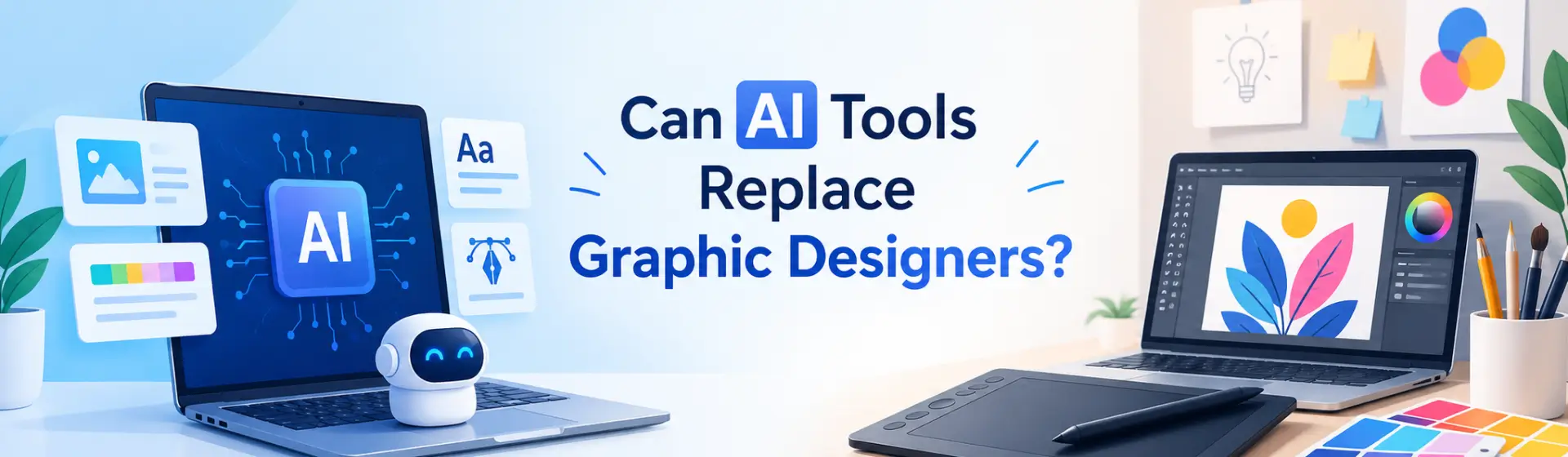
People love to frame AI vs Graphic Designers as a fight. It really isn't. They're simply good at different things.
AI is quick, and it never gets bored of making variations. Designers, though, understand people. They sense how a brand should feel before the client has said a word.
Choose a logo. AI can create one in seconds – but should it be used for a local bakery or a legal practice? That decision should be left to a person. What a font looks good with a colour, or what makes a page seem relaxed over feeling cluttered is a matter of experience.
So it comes down to technology on one side and human expertise on the other. The best work happens when both are in the room.
AI Impact on Graphic Designers
You can see the AI Impact on Graphic Designers in advertising, branding, social media, publishing, and digital marketing.
There's a good side. Designers can try more ideas without starting over each time. But there's a catch, too. Some entry-level tasks are fading because software now does them, and anyone who ignores that may feel it soon.
The solution is straightforward: learn the tools. A designer who masters working with AI is more efficient, and the clients will appreciate it.
Can AI Replace Graphic Designers Completely?
AI can replace tasks. Replacing a person is something else.
Good design starts with a reason. Who is it for? What does the brand stand for? What should the campaign achieve? A prompt box won't answer that. Besides, clients are unpredictable. They change their minds, send half-finished briefs, and ask you to "make it pop." Somebody has to turn that into a real solution.
AI can help along the way. Even so, a person makes the final call, which is why AI in Graphic Design will probably reshape the designer's role instead of erasing it.
The Future of Graphic Design With AI
The future of graphic design with AI looks like teamwork.
Designers will rely on AI for brainstorming, initial concepts, editing and production. They will put their efforts into art direction, storytelling, branding and problem-solving.
There's value to this even for beginners. In a Graphic Designing Course for Beginners, we always start with fundamentals to ensure your creations aren't mindless clicking.
It's also helpful to know what you're paying for. Tools will tell you what to click, but Courses will tell you why a design works. That is the real difference in AI Tools vs AI Courses.
Skills Graphic Designers Should Develop
To stay valuable in an AI-driven industry, designers should work on:
- Creative thinking and visual storytelling
- Typography and layout skills
- Branding and design strategy
- Communication and presentation skills
- AI-assisted design workflows
- Critical thinking and problem-solving
- Understanding of user experience
Get these right, and AI turns into a partner instead of a crutch.
Conclusion
AI in Graphic Design is transforming the design process. Deadlines get shorter, dull processes are reduced, and fresh new creative possibilities keep emerging.
Even so, AI can't easily copy the human understanding behind great design. The AI Impact on Graphic Designers will keep growing, but people who pair creativity with technology will be fine.
The future of graphic design with AI isn't humans versus machines. It's using both to make better, faster, and more meaningful work.
FAQs
1. Can AI completely replace graphic designers?
No. We say, "You need us to make amazing things, and be your creative partners, " because AI is good with the boring. But people will still make the art, strategize, communicate and exercise design judgment.
2. Is AI important in graphic design?
It enables designers to generate ideas, automate tasks, and tweak visuals and search for inspiration faster.
3. Should graphic designers learn AI tools?
Yes. They save time and they help designers stay ahead as creative work evolves.
4. What is the future of graphic design with AI?
Expect AI-assisted production paired with human creativity, strategic thinking, and creative direction.