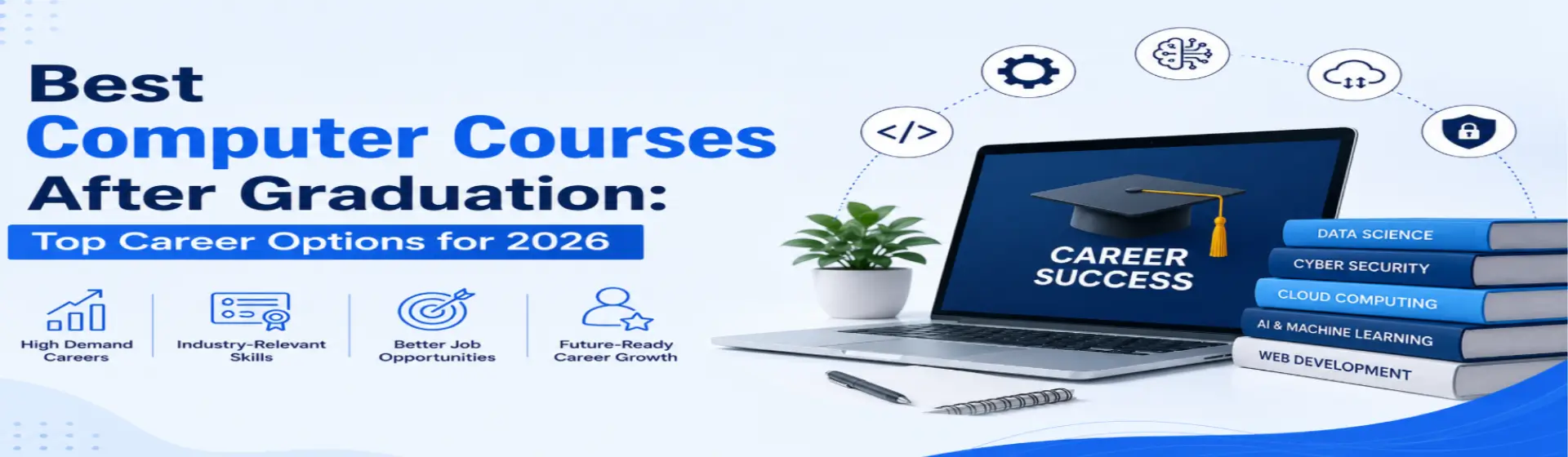
Here's a breakdown of what's actually worth your time.
Why Should You Take a Computer Course After Graduation?
Technology has quietly taken over almost every industry at this point. Hospitals run on software. Banks run on data. Even the small retail store down the street probably has some kind of digital system tracking stock now.
Employers have noticed this shift, obviously. They're not hiring purely on degrees anymore - they want people who already know how to work with data, code, security tools, or cloud platforms from day one.
A well-chosen course tends to help in a few concrete ways. More interviews, for one. Skills you can actually use instead of just theory you memorized for an exam. A push toward higher salary expectations, over time. And - maybe most importantly - future-proof skills, the kind that don't quietly expire in five years the way some tech trends do.
Best Computer Courses After Graduation
1. Data Science
Every company sitting on a mountain of data needs someone to make sense of it. That's the job, more or less. Recognize the pattern, anticipate what comes next, and instruct the company on what it needs to do about it.
Python, SQL, statistics, visualization, and even some machine learning will come into play. Most people end up becoming Data Analysts, Data Scientists, or Business Intelligence Analysts.. It's not a passing fad, either - this field has stayed near the top of "fastest-growing tech careers" lists for a good few years running now.
2. Artificial Intelligence and Machine Learning
AI stopped being science fiction a while back, whether we noticed or not. It's already running quietly in the background of hospitals, banks, retail chains, factories - places you wouldn't necessarily expect.
A decent AI course walks you through machine learning, deep learning, neural networks, Python, plus whatever tools are actually in use on the job right now (and that list changes fast). As companies lean harder into automation, someone has to build and maintain all of it. That's really the whole reason demand here keeps climbing instead of leveling off.
3. Full Stack Development
If building a website from scratch - front end, back end, database, the works - sounds exciting rather than exhausting, this one's probably for you.
HTML and CSS get you started. Then JavaScript, React, Node.js, and enough database knowledge to hold it all together. Full Stack Developers stay in demand for a fairly simple reason: one person who can build the entire application saves a company from hiring three separate specialists to do it.
4. Cloud Computing
Physical servers are fading out, slowly but surely. Everything's shifting to the cloud, and somebody has to actually manage that migration.
AWS, Microsoft Azure, and Google Cloud certifications are the ones that open real doors here - Cloud Engineer, Solutions Architect, Cloud Administrator, roles like that. Employers tend to notice certified candidates first, mostly because a poorly set-up cloud environment gets expensive fast, and nobody wants to be the one who signed off on it.
5. Cybersecurity
Cyberattacks aren't slowing down. If anything they're getting more creative, and that's exactly why companies are throwing real budget at people who can actually keep systems locked down.
Network security, ethical hacking, penetration testing, security operations – something like that is the typical format of most courses here. Digital security was once considered a footnote to all IT operations that took place behind the scenes. Now, it is discussed in the boardroom. That shift alone is why cybersecurity offers some of the strongest long-term career growth on this entire list.
6. Data Analytics
Not everyone wants to code all day. Fair enough. If numbers make sense to you and you're curious about what they're actually saying, Data Analytics is a gentler way in - especially useful if your degree wasn't technical to begin with.
Excel, SQL, Power BI, Tableau, a bit of Python - that covers most of the ground. It is one of the rarest IT fields for which candidates with education in commerce, arts or sciences can apply directly, without having to learn programming for several years.
How to Select an IT Course After Graduation
Not every course suits every person. Obvious, maybe, but easy to forget when you're just trying to pick something and move on.
Before signing up anywhere, sit with a few honest questions. What kind of work actually holds your attention - building things, or analyzing them? How much time can you realistically give this without quietly burning out halfway through? Are projects the focus of the class, or do most classes revolve around slide presentations and quizzes? Does the employer even recognize the certification or just receive a good looking PDF?
The best IT courses after graduation usually aren't the ones with the flashiest ads. They tend to be the ones that match how you actually think, and that leave you with something real to show afterward - not just a certificate to frame and forget about in a drawer.
Still early in your search? Our guide on top computer courses after 12th might be a better place to start. And if cost is the main worry, a government computer course can get you solid technical skills without draining your savings.
Conclusion
The computer courses after graduation you settle on now will quietly shape a good chunk of your career. More than most people realize while they're picking one.
Data Science, AI, Cloud Computing, Cybersecurity, Full Stack Development, Data Analytics - all six keep generating real opportunities across industries showing no real sign of slowing down. What actually matters, though, is what you do with the course once you're in it. Build things. Keep studying. Never give up half way when things get a bit tougher.
The technology isn't waiting on anyone to learn about it in their own time. Put the effort in toward future-proof skills now, and the next shift in the job market will find you in a far better position than it would otherwise.
FAQs
1. Which is the best computer course after graduation?
That depends on what you're hunting, really. Data Science, Artificial Intelligence, Cyber Security, Cloud Computing, and Full Stack Development are the most frequent in recent recruiting patterns.
2. Are graduates who are not technical allowed to pursue IT courses post-graduation?
Yes. Data Analytics, Digital Marketing, and several beginner-friendly programming courses are built specifically with commerce, arts, and science graduates in mind. No coding background needed to start.
3. Which IT course offers the best career growth?
Right now, that's AI, Cloud Computing, Cybersecurity, and Data Science. Not because any of them are trendy - but because demand for these specific skills keeps rising across nearly every industry, tech or otherwise.